
Sewer Line Failures Diagnosed Before Any Digging Starts
Sewer line repair in Lyndhurst, Charlottesville, Staunton, Harrisonburg, and surrounding areas for cracked, collapsed, or root-infiltrated sewer lines in older residential properties
Original clay and cast iron sewer lines in homes throughout Augusta and Albemarle County were installed when those materials were standard—and many of those lines are now old enough to crack at the joints, collapse under ground settlement, or admit tree roots at every seam. When that happens, backups do not stay isolated; waste moves backward into the lowest fixture in the house. Miller Plumbing Solutions, LLC locates the failure with a camera, shows you the footage, and walks through the repair options in plain terms before any excavation or pricing is confirmed.
The camera inspection is not a preliminary step that gets skipped when the problem looks obvious from the surface—it is how the actual fault location and its depth are confirmed, because a backup that appears to be mid-line is sometimes a collapsed section closer to the street or a root mass at a single joint that can be spot-repaired rather than replaced in full. The homeowner sees the footage and the options, including spot repair versus full line replacement, and the agreed scope and price precede any ground disturbance.
Request a camera inspection to confirm the condition and location of the fault in your sewer line before committing to a repair scope.
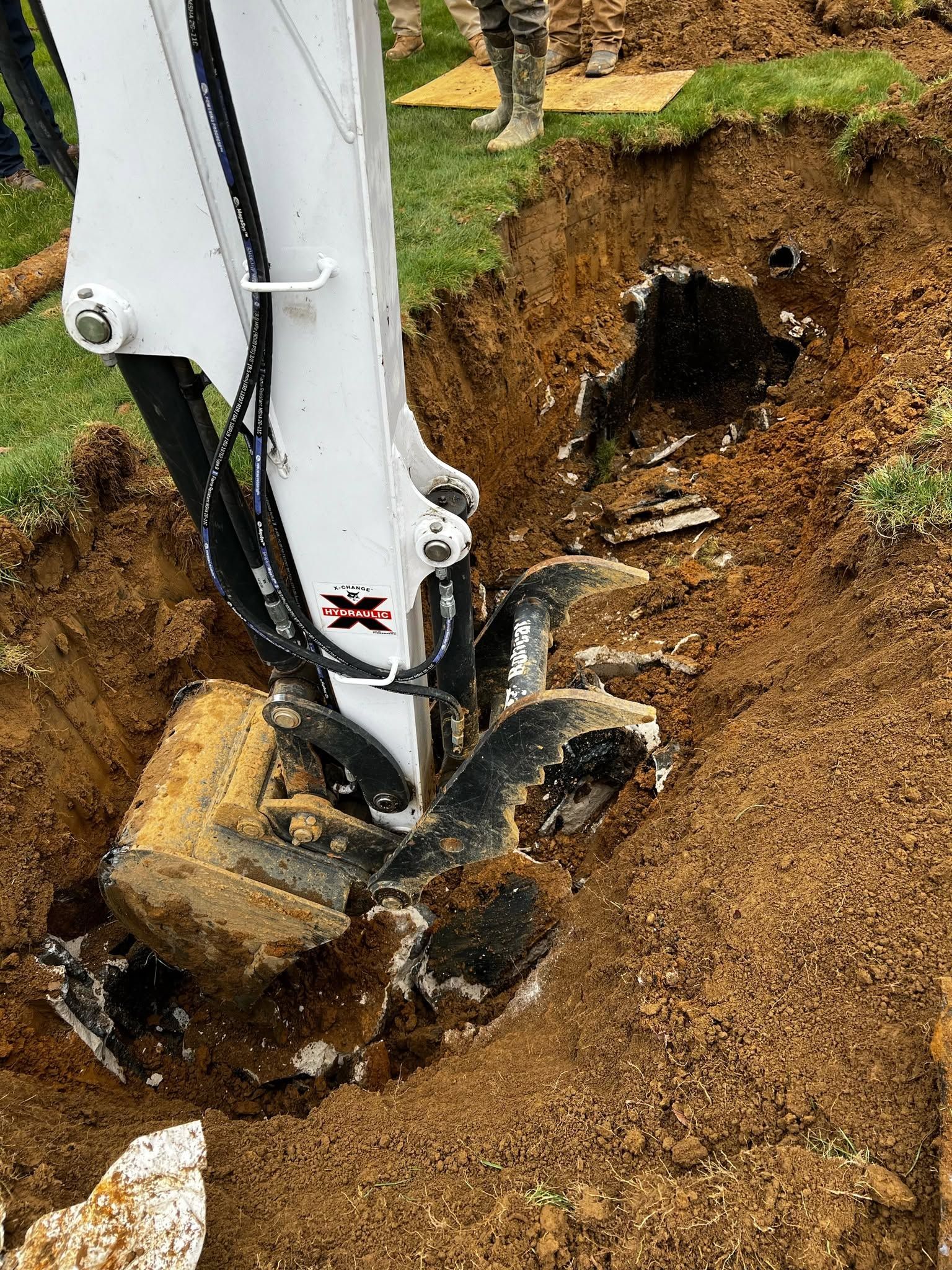
What Proper Sewer Line Repair Requires
Clay tile sewer lines, which were widely used through the mid-twentieth century in homes across Fishersville and the surrounding areas, fail differently than cast iron. Clay joints rely on mortar or rubber compression fittings that dry out and separate over decades, creating gaps where roots enter and ground water infiltrates. A spot repair at one of those joints is appropriate when the rest of the line is intact; full replacement becomes the correct call when the camera shows multiple failure points or a section that has deflected out of alignment and cannot carry waste by gravity.
After a successful repair, sewage backs up no longer, and fixtures at the lowest elevation in the house—typically a basement floor drain or ground-floor toilet—drain freely and without gurgling. The smell associated with sewer gas escaping through a cracked line also stops once the line is sealed and carrying waste correctly.
Virginia requires permits for sewer line work that involves opening the public right-of-way or connecting to the municipal main, and Miller Plumbing Solutions, LLC handles that coordination as part of the project scope rather than leaving it to the homeowner to manage separately.
Answers About How the Work Is Done
The questions below address how sewer line repair is scoped, how clay and cast iron lines behave differently, and what the repair process looks like from inspection through completion.
How does a camera inspection determine whether a spot repair is enough or the full line needs replacement?
The camera records the pipe condition along its entire length—the technician is looking for the number and spacing of failure points, whether the pipe has deflected out of grade, and whether root intrusion is isolated to one joint or distributed across the run.
What causes root intrusion in older sewer lines specifically?
Clay tile and older cast iron lines have physical joints every few feet, and as the joint material deteriorates, fine root tips follow moisture into the gap and then expand inside the pipe until they obstruct flow; a single compromised joint can admit enough root mass to cause a full backup.
How is excavation scoped so the dig is no larger than necessary?
The camera footage gives the depth and linear position of the failure, so the excavation is sized to expose only the damaged section rather than opening a trench along the full line run.
What should Lyndhurst homeowners expect during a sewer line repair on a property with original clay tile?
Clay lines in older Augusta County homes are often seated in compacted gravel beds that have shifted over decades, so the crew checks pipe grade after the repair section is set to confirm waste will still flow to the main by gravity rather than ponding at the repair point.
When is the repaired line tested and how is it confirmed to be functioning correctly?
Flow is tested after backfill is compacted and before the site is restored; the camera may be run a second time through the repaired section to confirm joint alignment and verify no deformation occurred during backfill.
Miller Plumbing Solutions, LLC also performs sewer line repair in Charlottesville, Crozet, Harrisonburg, and Waynesboro. To arrange a camera inspection and review your repair options, call (434) 437-0123.